

Welcome! On this page you will find a complete recorder notes chart where you can quickly learn all the notes of the soprano recorder. These charts show every note clearly with fingering diagrams, note names, and staff notation so beginners can understand them easily.
This recorder fingering chart is specially designed for students, teachers and kids who want to learn recorder notes step by step. You will first learn the natural notes and then the altered notes (sharps and flats), followed by chromatic and high notes charts.
If you are just starting, we recommend learning the natural notes first and practicing them slowly before moving to advanced fingerings.
Recorder Notes Chart – Natural Notes
The first chart shows the natural notes of the recorder arranged in ascending order. This order helps you practice the C major scale and understand how notes are organized on the instrument.
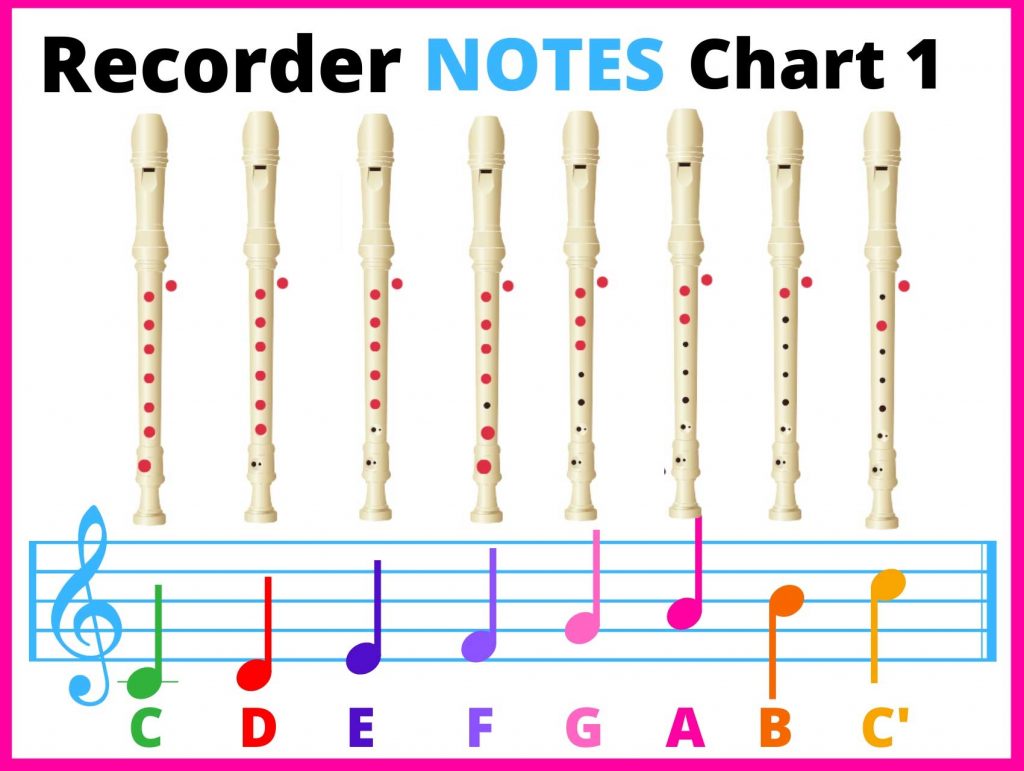
Each note in this chart includes:
- Finger placement diagram
- Letter name of the note
- Staff notation
- Color coding for easy recognition
These visual elements make learning recorder much easier, especially for beginners and children who are still learning to read music.
Recorder Fingering Chart – Sharps and Flats
This next recorder chart shows the altered notes. These include sharp notes and flat notes. Many of these fingerings are the same sound but have different names. For example, C sharp and D flat are enharmonic notes.

You only need to learn a few additional fingerings to complete the full chromatic scale on the recorder. Most altered notes are produced by lifting or partially uncovering specific holes.
Chromatic Recorder Scale Chart
The following chart shows all 12 notes of the chromatic scale. Once you can play these notes, you will be able to play most recorder songs.

Practicing the chromatic scale helps you improve finger coordination, accuracy and speed.
Recorder Fingering Chart for High Notes
High notes on the recorder require more precision. Many of them are played by partially covering the thumb hole or using special finger combinations. These notes extend the normal range of the soprano recorder.
You do not need these notes for beginner songs, but practicing them will improve your control and sound quality.

How to Use These Recorder Charts
- Start with natural notes
- Practice slowly
- Check finger placement carefully
- Listen to the audio examples
- Repeat daily for a few minutes
Consistency is the fastest way to learn recorder. Even five minutes of daily practice will help you improve quickly.
Who Are These Recorder Charts For?
These recorder fingering charts are perfect for:
- Beginners learning recorder
- Music students
- Teachers and classrooms
- Kids starting music lessons
- Self-taught learners
They are designed to be simple, visual and easy to understand so anyone can learn recorder notes step by step.